
Johannes Gutenberg
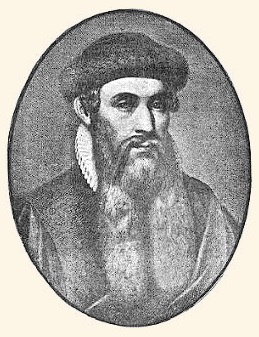
Johannes Gensfleisch zur Laden zum Gutenberg — birth name Johannes, called Henne (born c. 1400 in Mainz; died 3 February 1468 in Mainz) — was the inventor of printing with movable type.
c. 1400
Johannes Gensfleisch is born in Mainz in the Hof zum Gutenberg (the Gutenberg residence) and is probably baptised on 24 June (St John's Day) in the parish church of St Christoph.
c. 1419
Gutenberg's father, Friele Gensfleisch, dies in Mainz. In the following year, Gutenberg and his siblings have to go to court against their stepsister Patze over their shared father's estate.
1419/20
The matriculation register of the University of Erfurt records, for the winter semester of 1419/20, a Johannes de Altavilla, who may be Johannes Gutenberg — though this cannot be established with complete certainty.
c. 1428
In Mainz, partly on account of the city's desperate financial situation, there are repeated conflicts between the politically governing families, each supported either by the city's patricians or by the craft guilds. In protest against the tax demands of the council — which consisted predominantly of guild representatives — numerous members of the traditional ruling class, i.e. the patrician families, leave the city, among them Gutenberg and the Gensfleisch family.
1429–1434
Gutenberg's exact whereabouts during these years are uncertain.
1433
Gutenberg's mother, Else Wirich, dies in Mainz; her estate is divided among the three children Friele, Else and Henne (Johannes) Gensfleisch.
1434
First documentary evidence of Gutenberg's long residence in Strasbourg (1434–1444). The document tells us that Gutenberg had the Mainz town clerk Nikolaus von Wörrstadt imprisoned for debt at Strasbourg, in order to force the payment of 310 guilders in overdue annuity payments from the council of the city of Mainz.
1436/37
Gutenberg is sued before the ecclesiastical court in Strasbourg by Ennelin von der Isern Türe, the daughter of a Strasbourg citizen, over a broken promise of marriage. Whether Gutenberg subsequently married Ennelin, and how the proceedings ended, are both unrecorded. In the course of the case, Gutenberg describes Niklaus Schott, one of Ennelin's witnesses, as a poor, needy man who leads a poor, needy life through lies and deception. Schott then sues Gutenberg for defamation, and Gutenberg is ordered to pay 15 guilders.
1436–1444
In the entries of the Strasbourg Helbeling customs book — a register of the wine excise, or wine tax — Gutenberg appears at first among the Halbkonstofeler, that is, the not-quite-full members of the patrician association of the Konstofeler, but also as a half-member of the goldsmiths' guild, and again in the list of those belonging to no guild at all. In a muster roll drawn up by the city for the event of war, however, Gutenberg is recorded for the year 1443/44 in the group of patricians, or Konstofeler, owing half a horse as his required contribution to the city's defence. His social standing during the Strasbourg years thus remains unclear, but probably corresponded to that of a so-called Freimeister (a free master craftsman).
1439
In 1439 Gutenberg has to answer a case before the Strasbourg council. The records of the proceedings, including extensive witness testimony, are the principal sources on Gutenberg's commercial, artistic and technical activities in Strasbourg. They describe a training and working partnership between Gutenberg and various Strasbourg citizens — among them Andreas Dritzehn — for the manufacture of so-called pilgrim's mirrors for the great Aachen pilgrimage, but they also mention a second business partnership as well as a secret art of Gutenberg's that the partners were strictly to keep. Since, in connection with this trade secret, there is also mention of a press and of material "belonging to the printing," one may in all probability assume that Gutenberg had already put various elements of his invention into practice in Strasbourg and had carried out his first printing experiments there.
1441/1442
In connection with a loan of 100 pounds of Strasbourg denarii, which the squire Johann Karle borrowed from the St Thomas Collegiate Foundation in Strasbourg, Gutenberg appears as a wealthy guarantor. Only a year later, Gutenberg himself takes out a loan of 80 pounds of the same currency from the St Thomas Foundation — a debt he is unable to repay for the rest of his life, and on account of which he is repeatedly pursued in court, including before the imperial court at Rottweil.
1444–1448
No reports survive concerning Gutenberg's whereabouts and activities during this period.
1448
Gutenberg has returned to Mainz and, through the mediation of his relative Arnold Gelthuß, takes out a loan of 150 guilders at 5% interest, which he probably uses to perfect his invention further.
Before 1450
Gutenberg prints a poem on the Last Judgement in German, based on a Sibyllenbuch (Book of the Sibyls) composed in Thuringia around 1360. This, probably the earliest print attributed to Gutenberg, survives only in a small fragment, whose place and year of printing have so far not been conclusively established.
1450–1452
The Mainz lawyer Johannes Fust first lends Gutenberg the sum of 800 guilders for his costly project, which — besides setting up a printing workshop — also requires considerable sums for the hiring of wage-earning assistants. Probably as early as 1452, Fust invests a further 800 guilders as a partner in the joint enterprise, or, as the sources put it, the "work of the books."
Between 1452 and 1454
Printing of the 42-line Bible in Latin, in an estimated run of about 180 copies, some 30 of them on vellum. First copies are offered for sale, in the form of unbound printed gatherings, as early as the autumn of 1454 during the Frankfurt Imperial Diet by a "wondrous man" (vir mirabilis), who may well have been Gutenberg himself.
1454/55
Gutenberg's workshop prints the 30- and 31-line so-called "Cyprus indulgences," the proceeds of which Pope Calixtus III intends to use to finance a crusade against the Turks on Cyprus.
1455
The case brought by Fust against Gutenberg over the unpaid interest and principal is documented in a record named after the notary Ulrich Helmasperger — the so-called Helmasperger Notarial Instrument of 6 November 1455. Although only a single item from the entire proceedings, it is our most important source on Gutenberg's business dealings with Fust and on the printing of the 42-line Bible. In the case, whose outcome is not clearly recorded, Gutenberg probably loses the whole of the Bible printing as well as large parts of his printing workshop.
1457
In the Fust–Schöffer workshop the Mainz Psalter is completed, the first example of three-colour printing. A second edition, though with substantially altered text, appears in 1459.
1462
In the course of the dispute between the two rival archbishops of Mainz, the papally favoured candidate Adolf von Nassau captures the city in street fighting during the night of 28–29 October; it is then plundered and partly destroyed. Numerous families are banished from Mainz for a considerable time, their residences handed over to Adolf von Nassau's supporters. The Hof zum Gutenberg too changed hands in these years, which suggests that Johannes Gutenberg was likewise among the losers and victims of the Mainz Diocesan Feud. Several of Gutenberg's relatives are indeed recorded in exile in nearby Frankfurt during these years.
1465
The Archbishop of Mainz, Adolf von Nassau, takes Johannes Gutenberg into his household as a courtier and grants him, for the rest of his life, generous allowances of wine, grain and clothing, together with exemption from the taxes and services that the city's citizens ordinarily owe the Elector. The reasons behind this distinction have not so far been clarified.
1468
On 3 February 1468 Johannes Gutenberg dies in the Hof zum Algesheimer and is buried in the Franciscan church at Mainz (demolished in 1742). Within the same month, the former town syndic Dr Konrad Humery receives various pieces of printing equipment that Gutenberg had previously borrowed from him, on the express condition that they be used only within the city of Mainz.
1499
A first obituary of Johannes Gutenberg, written by Adam Gelthuß with the note that Gutenberg was buried in the Franciscan church at Mainz, appears in the book Ad illustrissimum Bavariae ducem Philippum, printed by Peter Friedberg in Mainz.
1504
The Mainz university professor Ivo Wittig has a memorial stone erected in the Hof zum Gutenberg, bearing the Latin inscription: "To Johannes Gutenberg of Mainz, who first of all invented the art of printing with type and thereby earned the gratitude of the whole world."
1565/1568
The first fictional portrait of Gutenberg appears as a woodcut in the first Latin edition of Heinrich Pantaleon's biographies of famous Germans, published in Basel. The German-language edition, issued only three years later, already contains a second portrait of the inventor, likewise based on no authentic or contemporary model. No reliable information survives about Gutenberg's actual appearance.
1741
In Leipzig, J. D. Köhler's programmatic tract Ehrenrettung Gutenbergs ("A Vindication of Gutenberg") appears.
1798
An assembly of European astronomers in Gotha resolves to add to the star chart the constellation lying between Argo Navis (the Ship), Monoceros (the Unicorn) and Canis Major (the Great Dog), as the constellation "Gutenberg." This decision was carried out by J. E. Bode. There were at least two editions of his widely circulated celestial charts. On both, the printer's workshop — the Officina Typographica / Atelier Typographique — is marked. Around 1825, these charts served as the model for an interesting teaching aid for the self-study of the night sky, "Urania's Mirror." This set of cards was reissued in 1993 in C. Tennant's The Box of Stars, including the constellation "Atelier Typographique."
1827
Erection of the first figural Gutenberg monument, created by the sculptor Joseph Scholl, in the Hof zum Gutenberg in Mainz (today displayed in the administrative building of the Gutenberg Museum).
1835
The astronomers Beer and Mädler, in their Mappa Selenographica, name a lunar crater "Guttemberg," which the International Astronomical Union (IAU) recognised in 1935 as "Gutenberg."
1837
Inauguration of the Gutenberg monument by the neoclassical sculptor Bertel Thorvaldsen, which became the model for many subsequent Gutenberg monuments.
1900
Founding of the Gutenberg Museum on the occasion of the celebrations marking the 500th anniversary of Johannes Gutenberg's birth.
1962
The Gutenberg Museum receives the title: World Museum of Printing.
1968
The 500th anniversary of Johannes Gutenberg's death is solemnly commemorated all over the world.
1992
Digital printing technology is born and well on its way to conquering the text and image media.
1998
Gutenberg is voted "Man of the Millennium" by American journalists — that is, the most important person of the second millennium.
2000
The city of Mainz celebrates the "Gutenberg Year" to mark the 600th anniversary of Gutenberg's birth.
2003
Books turn into e-books — thanks to new reading devices whose displays make digital text and images appear as though printed. The book trade faces upheaval. Is the printing industry facing its end?
Sources
Andreas Venzke: Johannes Gutenberg — Der Erfinder des Buchdrucks und seine Zeit. 3rd edition. Piper-Verlag, Munich 2000. ISBN 3-492-22921-2
Stadt Mainz (ed.): Gutenberg — Aventur und Kunst: vom Geheimunternehmen zur ersten Medienrevolution. Mainz 2000. ISBN 3-87439-507-3


All rights reserved by Ulrich Krentz.